We live in times, when everyday objects are expected not only to be functional, but also highly aesthetic.Previously – until the end of the 19th century – only a few could enjoy the surroundings of attractive forms, manufactured during an expensive and time-consuming process.
The breakthrough point in the history of design was the establishment of the Bauhaus Design School in 1914. Hence the ideas that are guided by modern designers of every field (including the creators of the technology industry) till this day. Standardization was the key direction of the upcoming changes. Repeatable components used on a large scale were to accelerate production and thus increase availability. The second aspect was functionality understood as ergonomics – related to the dimensional parameters of the human body, but also a psychological point – interest in emotional needs.
The design meets the software
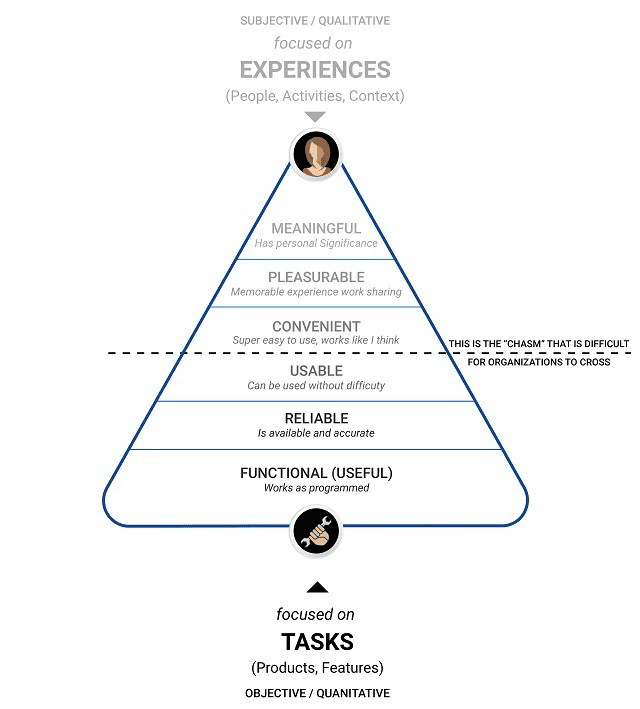
Until recently, the essence of software was to enable the user to achieve the goal and free himself from technical errors. The high competitiveness of various types of applications available on the market has forced the creators to strive for the best quality of the offered products. In addition to being functional and reliable, it must also be usable – intuitive. These three factors form the basis of the so-called ” User Experience Hierarchy Of Needs ” and must be met as standard needs.
To be competitive, your app should also be:
convenient – super easy to use – to work exactly as users expect it
pleasurable – to include all the extras, such as remarkable microcopy, excellent graphic design
meaningful – represents beliefs consistent with users
What’s the difference between UX design and UI design?
When working on projects, designers from various industries are usually guided by the principle “form follows function” (shaped along with the concept of industrial design). If we look at the meaning of UX and UI, we can notice that UX design is synonymous with function, while UI design is about form.
To be more specific, User eXperience designer:
researches and studies the needs and behavior of future or potential users
analyzes “customer journey” (the way the customers deal with the problems) and transforms it into a “user flow” (the way the software guides the customer when solving the problem)
creates and develops concepts, solutions for the users’ problems
forms wireframes and then prototypes
User Interface designer is responsible for the visual part of the application:
colors and typography,
composing graphics (however more advanced graphics are prepared by graphic designers)
creating layouts for the components
designing the interactions – the way the components or the entire interface respond to the triggers such as click, tap, swipe etc.
Both of these specializations are very often combined into one person – UX/UI designer. As we already know they are closely related and their coexistence is the key to creating memorable, high quality experiences.