Usability - what is it and why is it so important?
By definition, it’s a measure that determines the degree to which a product can be used by users to achieve specific goals in an effective and satisfactory manner. Usability criteria can be used to get some aspect of the user experience (UX).
In other words, it is all about creating the best experience, through the ease of use and access, for our users. The goal is to do everything possible not to associate bad emotions and impressions with our product. Because at the end of the day we want users to come back and enjoy it. To achieve this, we need to consider all aspects of usability.
The best 5 rules of usability
Jakob Nielsen, one of the best-known usability specialists named 5 basic rules of usability:
Learnability – measures how easy it is to learn how to use a product for the first time,
Efficiency – measures how quick user who already know the product can do a specific task,
Memorability – measures whether the user remembers how to use the product when they return to it after a period of time,
Errors – shows how many errors occur while using the product and what solutions are used to avoid them,
Satisfaction – the product is satisfying when the user finds it pleasant to use
USER EXPERIENCE
Nowadays, users expect a website or app to have all these aspects without even knowing it. This is why usability is so important, but it also brings a lot of pressure on the team. Designers have to reconcile business needs, developer limitations, and most importantly – user needs.
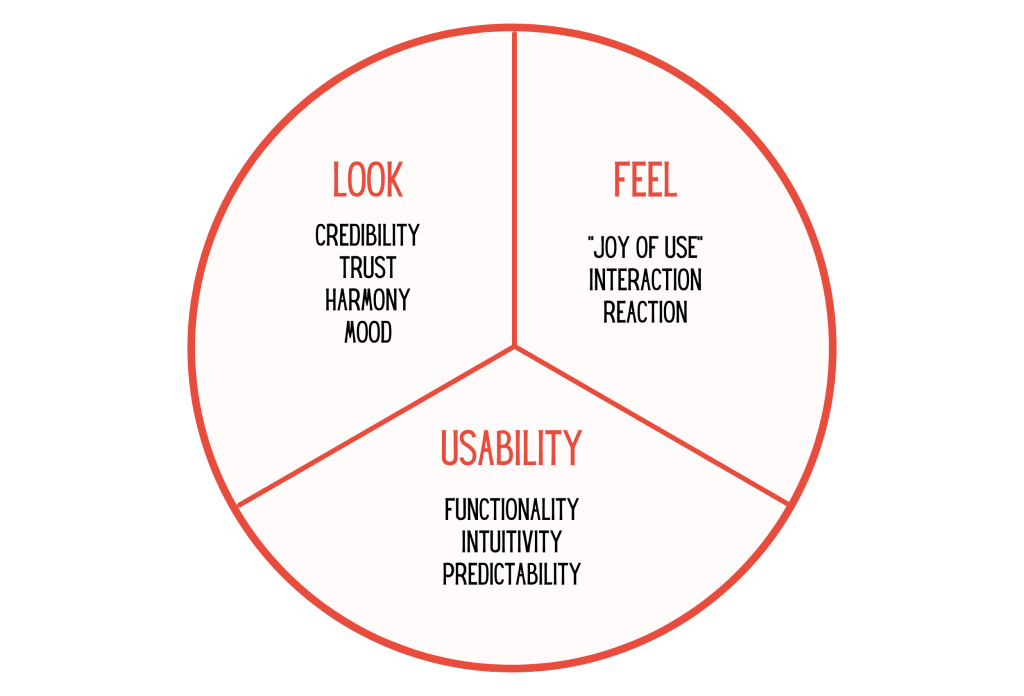
For example, if the user does not find what they were looking for, or will reach a dead end, then the product has failed and we’ve lost our user forever. We can say that usability is the foundation of every user experience. So only when we have usability then we can start working on other design stages like creating a pleasant look & feel of the product which brings more value, but it is pointless without the product being usable.
Both of these specializations are very often combined into one person – UX/UI designer. As we already know they are closely related and their coexistence is the key to creating memorable, high-quality experiences.
How to design a highly useful website?
The best known practice is to use the User Centered Design method. The steps can be described in a glance as follows:
Plan resources and time, get input and requirements from other stakeholders.
Understand and specify the context of use, e.g. through user research and input from market research.
Specify user requirements. This can include e.g. use cases, user interviews and other requirements.
Produce design solutions, like UX concepts, interaction and visual design and an interactive UI demo.
The UX design is evaluated by UX experts or testing with end users. If the user’s feedback is good, no other iterations are needed and the product can be delivered.
There are several evaluation methods for getting user’s feedback to improve usability. Some are based on an evaluation by UX experts, but probably the most common is usability testing with users. Additionally, questionnaires, interviews and focus group discussions, are used to collect as much data from users as possible. Sometimes users are also involved in the design process by attending workshops with designers.
Every product or website should be user-friendly. But creating a product that is easy and pleasurable to use, effective and efficient at the same time is a long and arduous process. Thanks to a lot of usability research, today we are able to come closer to the ideal and meet the user’s needs.